Our ability to deliver reliable results safely, on time, and on schedule is a function of the dedication of our entire team.
The time we devote to your project, from bid to completion, involves the attention of project managers, engineers, machinists, welders, mechanics, technicians in the field, and administrative staff in the office, all working together to ensure a successful outcome. Our technicians arrive on site with the experience, training, and certification needed to perform to the highest industry standards. When needed, our teams in the engineering office and fabrication shop are available for consultation 24/7.

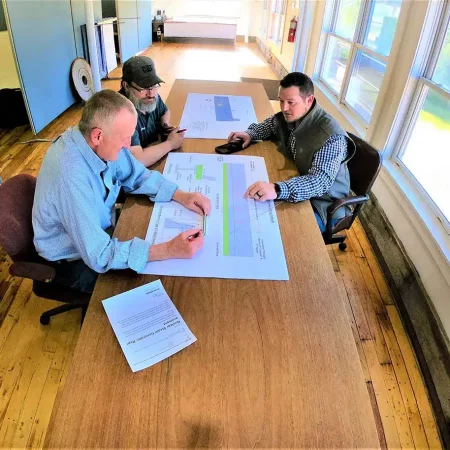
Every job, whether complex or straightforward, starts the same way at Bluegrass — with the engineering team and the field crew at the same table. When we took on the Submerged Crane Barge Recovery for McKinney Salvage located 30 miles south of Intracoastal City, LA, our engineering team built the cutting plan around the need to separate a 10-foot diameter steel pedestal at a depth of 25 feet, using a modified rail saw extended to 120 inches to accommodate an overturned, 600-ton crane vessel in rough seas, then walked it through with project managers and field technicians who would actually be on site, setting up and operating saws and other equipment.
That back-and-forth conversation doesn’t stop when the crew mobilizes. Our project managers, field technicians and machinists stay in contact with the engineering team throughout the job. When conditions on site don’t match the drawings — a frequent occurrence — we adjust the plan together rather than expecting the field team to make the call alone. It’s why our clients get an engineered solution instead of a guess, on projects ranging from nuclear decommissioning to heavy civil demolition.
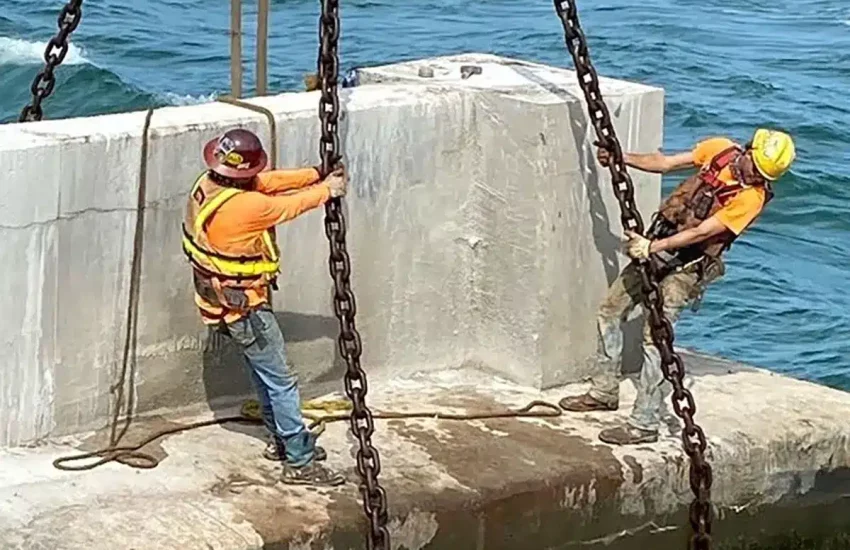
Precision cutting only looks effortless due to how much communication happens before the diamond wire ever begins cutting. On the Berth 29 removal project in Los Angeles, CA, our crew communicated seamlessly through every stage—from our engineers and machinists designing and building a bespoke 15-foot underwater diamond wire saw with patented four-wheel drive technology, to the careful deployment of equipment, management of power sources, and precise coordination between underwater saw operators and the crane rigging teams in real time so we could safely separate the 14.5-foot diameter concrete and metal sheet pile cell into massive 123- to 148-ton segments, ensuring each 24-hour cut sequence kept the remaining structure stable and ready for safe crane extraction.
It’s the same story on land: when we bring in a Brokk robotic hammer for a confined-space demolition, the operator running the remote control is in constant contact with the spotter and the site engineer, because a single miscommunication in a tight space can turn a clean cut into a costly delay.
That coordination is what lets us deliver a solution in which vibration, effluents and combustibles are controlled — which is the point of choosing diamond wire and robotic hammering over explosive demolition in the first place.
Whether we’re on a refueling outage at Sequoyah Nuclear Plant in Soddy-Daisy, TN, cutting topside steel on a platform in the Gulf of Mexico, or sizing concrete blocks for removal on a heavy civil demolition job like the San Francisco–Oakland Bay Bridge, the standard doesn’t change: every technician on a Bluegrass crew is trained and expected to speak up if something looks wrong, no matter their title. We run a thorough job hazard analysis before the job starts, another during the operation, and a post-contract review when it wraps. We conduct daily safety meetings, and during a job it’s the crew watching out for each other that catches things a checklist can miss. Our technicians carry OSHA 10/30, HAZWOPER 40, Radworker I and II, TWIC, BOSIET, and Safe Gulf certifications depending on the site, but our culture of disciplined safety underpins the entire operation, and nobody goes home hurt because every member of the crew is alert and paying attention.
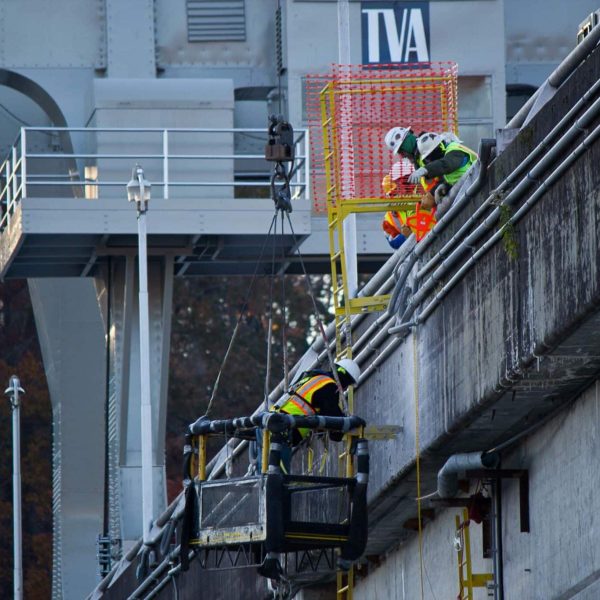
When we get a call because a critical path project has gone sideways — a scheduled lock maintenance that will shut down a shipping channel, or a bridge pier repair which must occur within a time window, or a critical path outage at a major intersection like our work for DH Griffin Construction at Highway 290 and Beltway 8 Click to open side panel for more information in Houston, TX — the Bluegrass teams rally. Our engineering and fabrication teams can produce a proposal including schedule, mobilization logistics, equipment, and operators. That kind of rapid response is only possible because the office and the field aren’t operating on separate timelines — everybody understands that minimizing downtime for the client is the job, not an afterthought. In fact, by maintaining that tight coordination and running two saws simultaneously during the Highway 290 outage, we mobilized, made three cuts, released 105 tons of concrete, and left reusable columns intact all within a shift and a half.
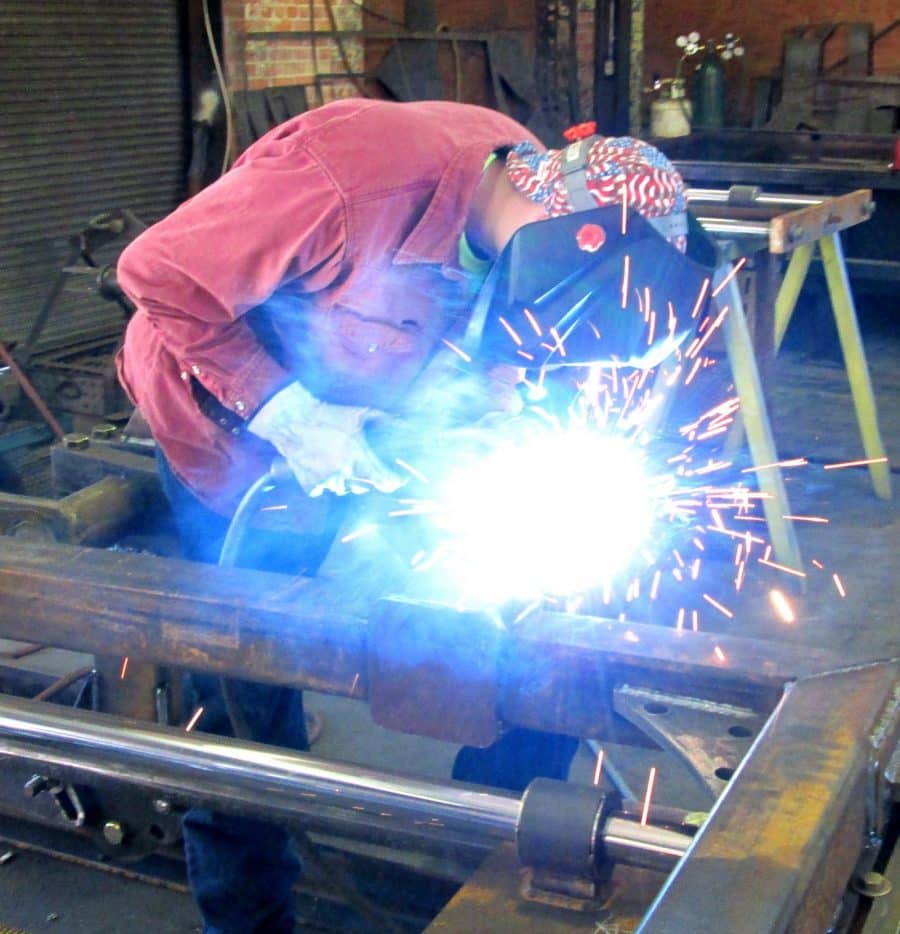
Bluegrass didn’t invent diamond wire sawing as a feasible, reliable, non-explosive demolition method by having engineers work in isolation — we did it by overlapping machinists, field technicians, and engineers in the same shop and encouraging them to design a better diamond wire saw. That’s still how it works today. Our in-house Machine Shop in Greenville, AL, builds and tests saws based on problems our field crews bring back from job sites, whether that’s a plunge saw that needs to work on a dam face, or an underwater, ROV-friendly saw design for use on an offshore platform. When a technician in the field has an idea for how to shave an hour off a setup, that idea makes it back to the engineers who design, build and test that idea in the next saw. Forty-plus years of “we cut anything” only holds up because the people doing the cutting are the ones driving the innovation.
If you want to know who we are at our core: we’re a company where the field technician running a diamond wire saw and the engineer who designed the cutting plan are treated as equally essential to the outcome. We recruit and train our own people, and a technician who starts in the field can grow into project management, engineering, job supervision, or the machine shop because we invest in that path rather than treating crew members as exchangeable labor. Compared to a typical construction job, where crews rotate and turnover is high, Bluegrass technicians work alongside the same engineers and project supervisors project after project, which builds the kind of trust that lets a crew move fast and safely on a nuclear, offshore, or heavy industrial site. For anyone looking at demolition careers, that’s the incentive: come learn a genuinely specialized trade, where you are part of a team that has your back on-site, and grow with a company that’s been solving the toughest cutting and decommissioning problems in the industry since 1979.